


by Dave Gold, CIH CSP
President, Gold Health and Safety Consulting, Inc.
October 29, 2025
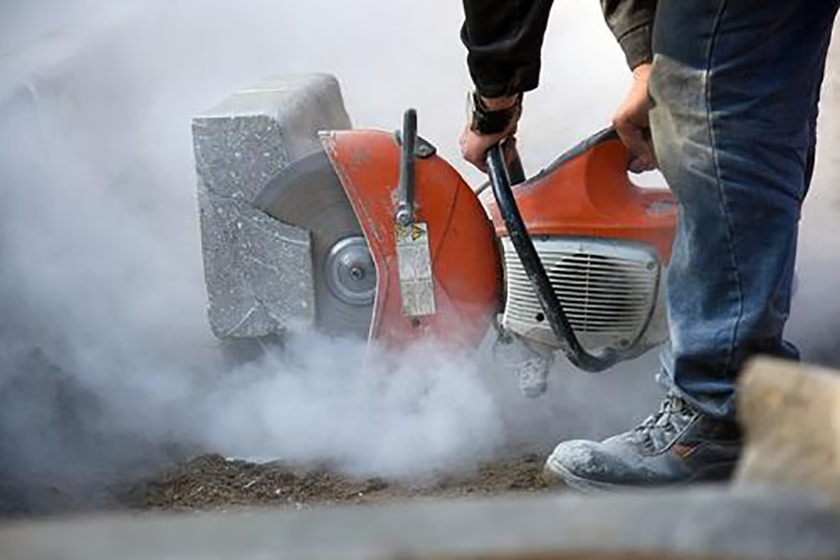
Are you aware that working with crystalline silica requires periodic monitoring per Cal/OSHA? This is your reminder! Many business owners recently have faced surprise inspections with citations because they fell behind on the required periodic sampling, didn’t have a written program, respirator compliance issues including training and fit testing, and more. Staying compliant protects your employees and keeps your business running smoothly, so don’t forget these important tips.
Cal/OSHA has greatly increased enforcement of the updated Respirable Crystalline Silica Standards (8 CCR Section 5204 for general industry). The Permissible Exposure Limit (PEL) remains at 50 micrograms per cubic meter as an eight-hour time-weighted average. Enforcement is now focused on whether your company is keeping up with routine air sampling and proper employee protection, especially respirators.
Updated Enforcement and Routine Monitoring
- If exposures exceed the PEL (50 µg/m³), testing must be repeated every three months.
- If results are between the Action Level (25 µg/m³) and the PEL, testing must occur every six months.
- If results are below the Action Level, testing must occur annually.
Tip: Retest when materials, tools, processes, staffing, or controls change, catch issues early and avoid citations.
If you haven’t done your initial sampling yet, or kept up with your routine sampling, you could be facing serious fines,and worse, unknowingly exposing employees to dangerous crystalline silica.
Respiratory Protection
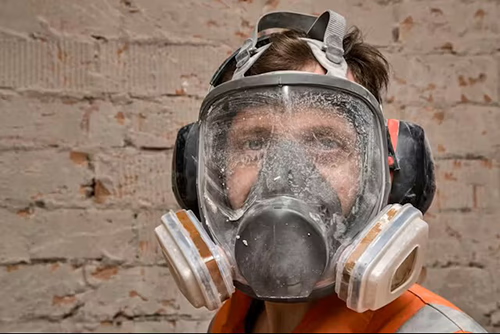
The respiratory protection requirements in §5204 are a critical part of compliance. When performing countertop or construction work such as cutting, grinding, or polishing (“trigger tasks”), your employees must use respiratory protection, and your company must follow Cal/OSHA §5144. This includes selecting the correct respirator type, conducting medical evaluations before use, providing annual fit testing, and maintaining records of all training and testing. The correct respirator type is determined by the results of your air samples,but in most cases, full-face respirators or better are required.
If your sampling results are consistently under the Action Level, you have the option of using a disposable-style P100 respirator (like this one). This means you won’t have to follow the requirements of the Respiratory Protection Standard (Section 5144), but you will need to give your employees Appendix D of Section 5144. This exemption greatly simplifies things, and will save you money and time dealing with respiratory protection management. However, the exemption requires sampling two times a year – which is really only one more time that what would be otherwise required. You would also still need to provide some training on the P100 respirators, as well as fit testing.
Written Exposure Control Plan
In addition to sampling and respirator use, every employer must maintain a written exposure control plan. This plan identifies tasks where exposure may occur, outlines engineering and work practice controls, includes housekeeping and PPE requirements, and designates a competent person to oversee implementation. Outdated or missing plans remain one of the most common Cal/OSHA violations.
Medical Exams
Medical exams are also a required part of the Respirable Crystalline Silica Standards. An initial exam is required for any employee performing trigger tasks or working above the Action Level, followed by reexaminations every three years. Exams are also required for employees who wear respirators and typically include chest X-rays, pulmonary function testing, and a written medical opinion from a licensed healthcare professional. This documentation is vital for both compliance and worker health.
Stay Compliant and Protect Your Team
Failing to stay up to date with any of these requirements can result in penalties, work stoppages, and reputational damage. Fortunately, compliance is simple with the right guidance and documentation in place.
Gold Health & Safety Consulting has helped dozens of California companies complete exposure sampling, conduct fit testing, and develop written compliance programs. Our mission is to help good companies stay in business, avoid costly citations, and protect their workers. If you’re unsure where your program stands,or need help bringing it up to date, contact us today. Staying compliant keeps your employees safe and your business open, and at Gold Health & Safety, we make that easy for you.


