


by Dave Gold, CIH CSP
President, Gold Health and Safety Consulting, Inc.
December 4, 2025
Hopefully, you’ve read my accompanying article A Look Back At What We Learned And What You Need To Know. As I mentioned, we have used our experience with testing contaminated and remediated homes to form our opinions and recommendations on what makes sense for testing homes that were affected by the wildfire.
So, what do we recommend that people test for post-remediation?
What Kind of Samples Should I Get?
- Airborne Particulates One of our foremost recommendations is to monitor for respirable airborne particulates. This is the best overall indicator of air quality after wildfire remediation. We know from the National Institutes of Health study on the Marshal Fire, that particulate matter is one of the biggest hazards for homes that got contaminated. The particulate matter is going to contain the bulk of the nasty stuff. In practice, we have found a few homes that didn’t pass and needed to be recleaned, but for the most part, houses that were thoroughly cleaned come out okay. The cost for these samples is not terribly expensive.
Rather than sample for just the smaller particulate matter (PM 2.5), we like to take a broader approach and sample for all particles that can reach the respiratory system, which includes both PM 2.5 and PM 10 particles. The equipment for measuring just PM 2.5 is less dependable, and by measuring both we can compare the results against the acceptable level of the California Ambient Air Pollution Standards. If the interior is below the level that is set for the general public for air pollution outdoors, you should be good to go.
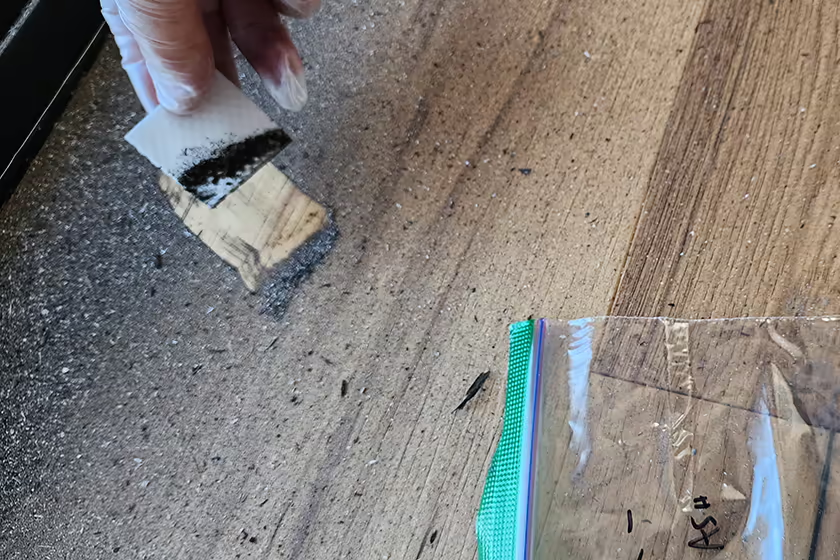
- Should you do combustion particulate wipes? Probably not, unless debris is visible and you want proof the home was not cleaned well enough. Conversely, if you are not seeing combustion debris, a wipe is going to be negative. Let’s also not forget the importance of a visual inspection – If we see combustion debris, the house is not ready to pass inspection! This has come up several times.
- Lead Wipes If you had lead contamination in your home, you should absolutely re-sample for lead. Unlike our initial samples for lead, these are taken by the square foot so we can compare them against the HUD-EPA lead standards. The lowest standard is for floors, because of the potential exposure risk to babies and toddlers. We recommend that people concentrate on floor areas where the debris were known to have landed. More discussion on how many samples to collect is below.
- Other Metals What about the other metals, such as arsenic, beryllium, and cobalt? I’m not as concerned about these for a couple of reasons. First, the method to clean metals is all the same. If you clean up the lead, the other metals are getting cleaned up too. Secondly, the lead contamination is way higher in proportion to any other metal found. So, if the lead is gone, and it was 98 percent of the contamination, the other metals are going to be gone too. In practice, this works – you can pretty much use lead as a surrogate. At a recent industrial hygiene conference I attended, some other CIHs I’m friends with agree on this point.
Some people have requested more extensive metal testing, such as the CAM-17 or RCRA methods. A lot of the metals in the CAM-17 and RCRA have not been identified as being problems as a result of the wildfires, so to test for many different metals is wasteful. If you really want to test for more metals than lead, just add those metals of concern (such as Beryllium, Cobalt, Arsenic, Lithium, etc.) to your lead wipe samples. The analysis method for CAM-17 and RCRA is essentially the same (ICP) as it is for the lead wipes, and you will save money. Another approach would be to have just a few of your samples with additional metals, and the majority of them be for lead alone. Frankly, I would rather see people spend money on taking more samples for lead than spending the money on extensive multi-metal analysis.
- VOC Sampling In my opinion, this is a waste of money. As discussed previously, we have not found anything significant throughout the wildfire response, and this is consistent with what we would expect from experience with other wildfires, especially 10 months afterwards. It’s also expensive. Some people still request them for peace of mind, and we are happy to do them, so long as we get on our soapbox first, and tell the client that we would expect results to come back negative.
- If you do get VOC sampling done, is it necessary to run them for 24 hours, as some “scientists” have recommended? In my opinion, no. The TO-15 method collects a finite amount of air, so sampling longer is not going to make the test more sensitive. The sensitivity for TO-15 is already excellent (down to 0.01 parts per billion). Plus, since the concentration of VOCs is likely to be higher during the daytime (when it is warmer), you would actually have a lower concentration if you run the sample overnight.
- Semi-Volatile Organics Some people have requested sampling for semi-volatile organic compounds by TO-17, which will include some fire residue indicators, and things like formaldehyde. We don’t have a lot of data about the value of this at this time, but thus far the results look okay, and below any recommended action level. One issue with testing for formaldehyde is that it is a common problem indoors, and if you have done recent remodeling involving manufactured wood products (particle board, MDF, plywood, laminates – which can be in cabinetry, wood floors, moldings, and furniture), your formaldehyde may have been pre-existing. TO-17 can pick up a wider variety of chemicals than TO-15, but it is not as sensitive as TO-15 for VOCs, which we prefer. The cost is about the same.
- Cyanide Sampling In my opinion, it is also a waste of money. We have found nothing airborne every time we have tested for it (and airborne is the main concern), down to a very low detection level. Again, we have some people that still request it, and we will get it done for them.
- PAH Sampling We have found no PAHs, either before or after remediation. So, I don’t think there is any value in sampling for them, plus it is expensive.
What About Peace of Mind?
Now that we have talked about all the technical stuff, what about your peace of mind? I’ve mentioned several times that some people want samples that we have found to be needless. When this happens, we explain our position, and if the client still wants a certain kind of sample (like VOCs) we are still willing to go ahead and collect those samples. This is because we certainly don’t want to lose that business, plus I worry about what someone else will do for the client – will they get overcharged, and be subject to alarmism? I could write another blog article about that topic alone!
That being said, we cannot put a price on a client’s peace of mind. If someone feels that they need certain samples, we want to accommodate them even if we think they are not needed.
How Many Samples Should I Get?
How many samples should be collected post-remediation for your home? Well, again, there is no right answer, or particular formula to use. The best answer is to ask yourself, “How many samples do I need to assure that the house is clean?” That might be more or less for some people in the same size home. Typically, for a 1500 square foot home, we are going to recommend around 7 sample sets. Some people are going to want more, and some less. There are also budgetary considerations.
Where should I have the sampling done? This is another good question, and again, with no right or wrong answer. There are several options:
- The areas that were the worst in the home. If one side of the home got hit with wildfire residues compared to another, focus testing on those heavier areas, but maybe get a few from further away also.
- The areas where people hang out the most (family room, bedroom, kitchen) as those will create the greatest exposure risk.
- You can also think about geographic distribution. For instance, if the house has multiple floors, you will probably want to spread the samples around a bit.
If you have any further questions, or would like more information on what would be the best course of action for your specific situation, please reach out to us. We are always available to help!


